What Is a Pre-Execution Authority Gate?
One-line definition
A pre-execution authority gate is a sealed runtime that answers, for every high-risk action:
“May this specific action run at all — by this person or system, in this context, under this authority, right now: approve, refuse, or supervised override?”
It doesn’t draft, predict, or explain.
It decides what is allowed to execute at all.
Action Governance is the discipline.
The Commit Layer is where it lives.
Refusal Infrastructure is the architecture.
SEAL Runtime is the product.
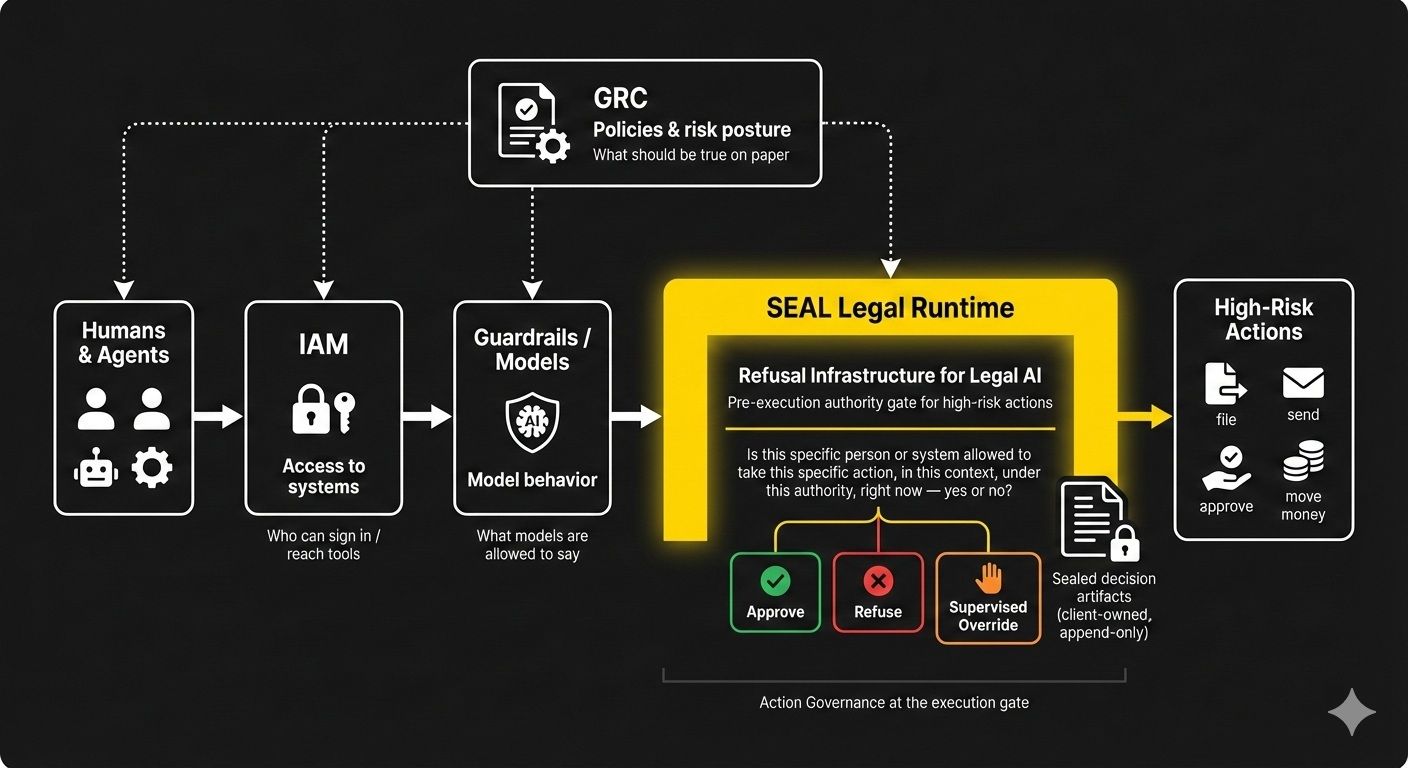
Why This Category Exists
Most “AI governance” tools live in two places:
- Formation – data controls, model guardrails, and observability that explain what a system saw and thought.
- Forensics – logs, dashboards, and reports that explain what already happened.
What’s been missing is the layer that answers the board / regulator question:
“Who was allowed to let this happen?”
That missing layer is the Commit Layer.
A pre-execution authority gate is the control point that lives there.
- Formation controls what the model may see and say.
- Forensics explains damage after the fact.
- The pre-execution authority gate controls which actions may touch the real world.
Alignment without containment is just persuasion.
Governed execution, at scale, needs a gate.
Where the Gate Lives in the Stack
AI governance now has two stacks plus one missing layer:
1. Formation Stack – Data & Model Perimeter
Controls what the system knows and says:
- DLP, “no public LLM for client data” rules
- Approved AI endpoints and proxies
- Model governance, reasoning traces, RCTs, drift monitoring
This stack solves: what the model saw and how it reasoned.
2. Commit Layer – Action Governance at the execution boundary
Controls whether a governed high-risk action may execute at all:
- File / send / sign
- Submit to courts or regulators
- Approve payments or changes
3. Forensics Stack – Monitoring, logs, and reconstruction
Explains what already happened.
- Monitoring
- Logs
- Dashboards
The pre-execution authority gate sits in the Commit Layer — downstream of identity and policy, upstream of any irreversible action.
If a workflow is wired through the gate, every request on that path hits the same structural checks.
If it’s not wired, it’s out of scope.
Coverage is explicit, not implied.
What a Pre-Execution Authority Gate Actually Does
For each governed request (“intent to act”), the gate receives a small, structured payload and evaluates five anchors your systems already know:
- Who is acting?
Partner, associate, staff, system account, AI agent. - Where are they acting?
Practice / domain / venue / environment. - What are they trying to do?
e.g., file motion to dismiss, send filing, release funds. - How fast is it meant to move?
Standard, expedited, emergency. - Under whose authority or consent?
Client consent, contracts, internal policy, regulation, delegated authority.
From there, a true pre-execution authority gate has four defining properties:
- Authority-centric
It doesn’t care whether the draft came from a junior, a partner, or an LLM.
It only answers: may this actor take this action, here, now, under these rules? - Operator-agnostic
Humans, agents, and workflows all hit the same gate.
There is no “AI shortcut lane.” - Fail-closed by design
Unknown role, missing consent, broken context, ambiguous scope → refusal, not “best effort.” - Sealed evidence for every decision
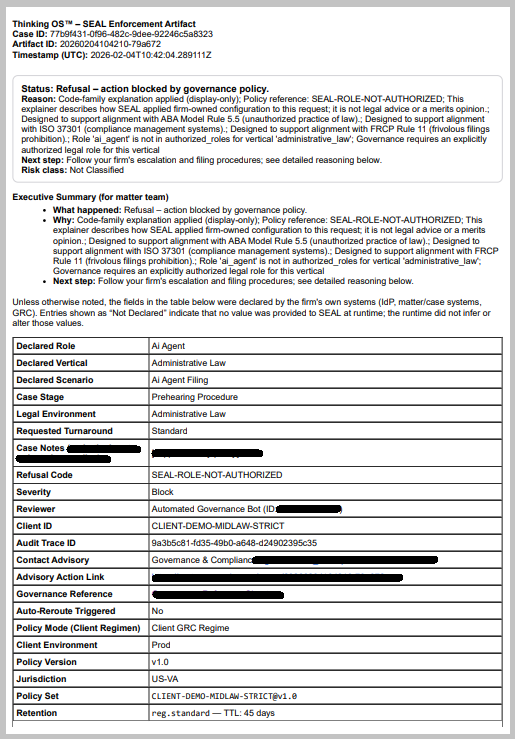
Every approve / refuse / supervised override produces a sealed artifact, not just another log line:
- unique decision / trace reference
- integrity-verifiable artifact reference
- who / where / what / how fast / authority-or-consent anchors
- high-level reason categories
- short human-readable rationale
Artifacts are designed for tenant-controlled audit retention and review and are shaped for regulators, insurers, courts, and internal oversight — without exposing prompts or internal runtime details.
If those four are missing, you don’t have a pre-execution authority gate.
You have governance-adjacent tooling wearing the label.
Screenshot below is from a simulated matter where a governed actor attempted to file under the wrong authority. The pre-execution authority gate refused the action and produced a refusal artifact the firm can use for regulator, insurer, or internal review later.
How It Differs from Existing Controls
A pre-execution authority gate is not:
- IAM – IAM governs who can sign in or see a system.
The gate governs what even a properly authenticated actor may do. - Model guardrails / safety – Guardrails shape what a model is allowed to
say.
The gate decides whether any resulting action is allowed to run at all. - GRC platforms – GRC systems manage policies, attestations, and documentation.
The gate is the runtime enforcement point for those policies in live workflows. - Monitoring / observability – Traces and dashboards tell you what happened.
The gate determines what is allowed to happen in the first place.
Formation tools explain and monitor.
A pre-execution authority gate authorizes and refuses.
You need both — but only one can prevent an unsafe action before it executes.
The Legal Example: SEAL Legal Runtime
Law is the clearest proving ground: once something is filed, sent, or disclosed, it cannot be “un-filed.”
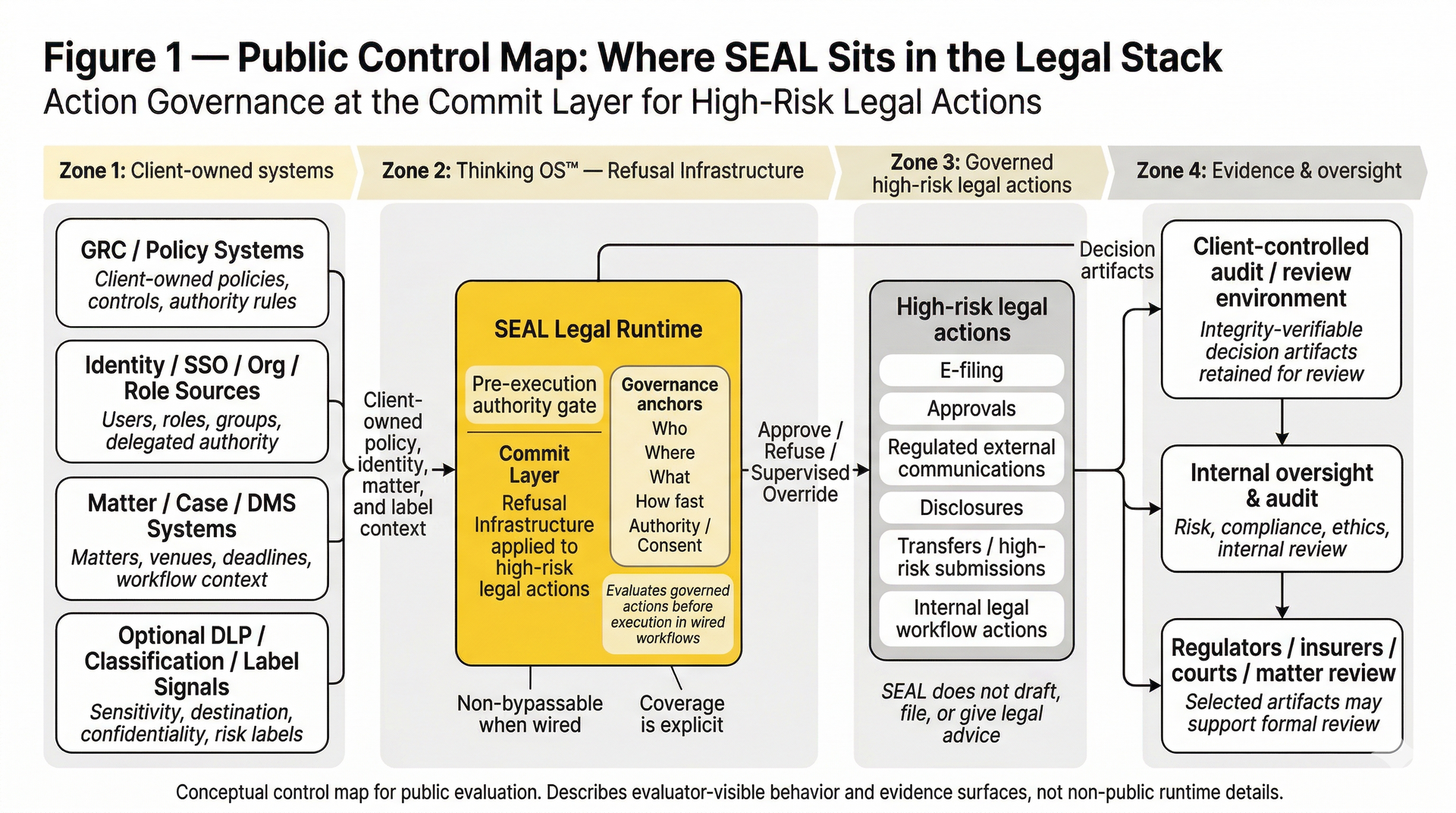
SEAL Legal Runtime, built on Thinking OS™, is a pre-execution authority gate for high-risk legal actions in AI-assisted and automated workflows:
- Sits between a firm’s internal tools (DMS, case systems, AI drafting tools, e-filing portals) and external destinations (courts, regulators, counterparties).
- In wired workflows, every high-risk action hits the gate before it leaves the firm.
- Evaluates who / where / what / how fast / consent using the firm’s own:
- IdP / SSO and org chart
- GRC / policy systems
- Matter and venue systems
- (Optionally) DLP / classification labels
At runtime SEAL returns:
- Approve – tools proceed as designed.
- Refuse – the action is blocked; nothing is filed or sent.
- Supervised override – the action is routed to a named supervisor under the firm’s override rules.
Every decision produces a sealed approval, refusal, or override artifact that can be attached to matters, surfaced to internal audit, or included in regulator / insurer packets.
SEAL never drafts documents, picks arguments, or replaces attorney judgment.
It governswho may act, on what, under whose authorityat the execution gate — and proves it.
Where This Pattern Goes Next
The category is general:
- financial controls and payments
- healthcare orders and triage
- critical infrastructure operations
- public sector and defense systems
Anywhere the core question is:
“Who is allowed to let this action hit the real world?”
…the answer is going to require Action Governance at the Commit Layer.
The Takeaway
Most of the AI industry is still focused on making systems smarter or faster.
Pre-execution authority gates are about making them
governable:
- Bounded – actions constrained by role, context, and authority.
- Traceable – sealed artifacts for every governed decision.
- Refusable – unsafe actions are blocked, not merely explained afterward.
It’s not another tool inside the system.
It’s the door at the exit, refusing what should never leave.
In legal, financial, and other regulated environments, that door is becoming non-optional.
Thinking OS™ builds Refusal Infrastructure.
SEAL Legal Runtime applies it to high-risk legal actions.
It is a pre-execution authority gate that sits in the Commit Layer, enforces Action Governance at runtime, and produces decision artifacts designed for review by courts, regulators, insurers, and internal oversight.