What Is a Pre-Execution Authority Gate?
One-line definition
A pre-execution authority gate is a control mechanism that determines, at the Commit Layer and before institutional commitment, whether a scoped consequential action may proceed, must be refused, or requires an authorized supervised path.
Its question is narrow:
May this actor take this action, in this context, under this authority, before the institution is committed?
It does not decide what the actor should say, what legal strategy is correct, or whether an upstream system is otherwise fit for use.
It governs whether the particular action has authority to proceed.
Action Governance is the discipline.
The Commit Layer is the control point.
Refusal Infrastructure is the architecture.
A pre-execution authority gate is the control type.
SEAL Legal Runtime is Thinking OS™’s legal product.
Why This Control Type Exists
Institutions already govern important prerequisites to consequential action:
- identity and access;
- policy;
- data and security;
- model behavior and validation;
- authority and supervision;
- monitoring and audit.
All are necessary.
But once those prerequisites are satisfied and an action is ready to bind the institution, a narrower question remains:
Is this particular action authorized to proceed right now?
A pre-execution authority gate exists to put that decision in the path capable of causing the consequence.
It is not a replacement for upstream governance or after-the-fact evidence.
It owns the authority decision before commitment.
Where a Pre-Execution Authority Gate Operates
A pre-execution authority gate operates at the Commit Layer.
It sits:
Downstream of prerequisites
Identity, policy, validation, context, authority, consent, evidence, and other upstream controls establish the facts and conditions the action depends on.
Upstream of commitment
The gate evaluates the scoped action before the filing leaves, approval binds, money moves, disclosure goes out, or another consequential act commits the institution.
Inside the governed execution path
For the gate to control the consequence, it must sit in the path capable of causing that consequence.
“Before execution” is not enough. The gate must be in the path that actually binds the institution.
Scope is explicit
Only paths wired through the governed boundary are in scope.
Alternate paths remain outside the controlled surface until the institution brings them under workflow control.
What a Pre-Execution Authority Gate Evaluates
The gate receives the minimum trusted governance context required to determine authority for the scoped action.
Depending on the workflow, that may include:
- who is acting;
- the trusted role or authority of the actor;
- what action is being attempted;
- the relevant matter, system, domain, or context;
- required authority, consent, evidence, or supervision;
- timing or urgency where material.
The gate does not invent those facts.
They come from the institution’s upstream systems and configured governance posture.
The gate answers:
Given these trusted conditions, may this particular action proceed?
Thinking OS™ implements this control type through Refusal Infrastructure, with fail-closed behavior and reviewable decision evidence for governed workflows.
The Control Is Actor-Neutral
The authority question does not depend on whether the actor is human or machine.
A governed action may be initiated by:
- a human;
- service account;
- workflow;
- automation;
- script;
- integrated system;
- AI agent.
Capabilities differ.
The authority question remains the same.
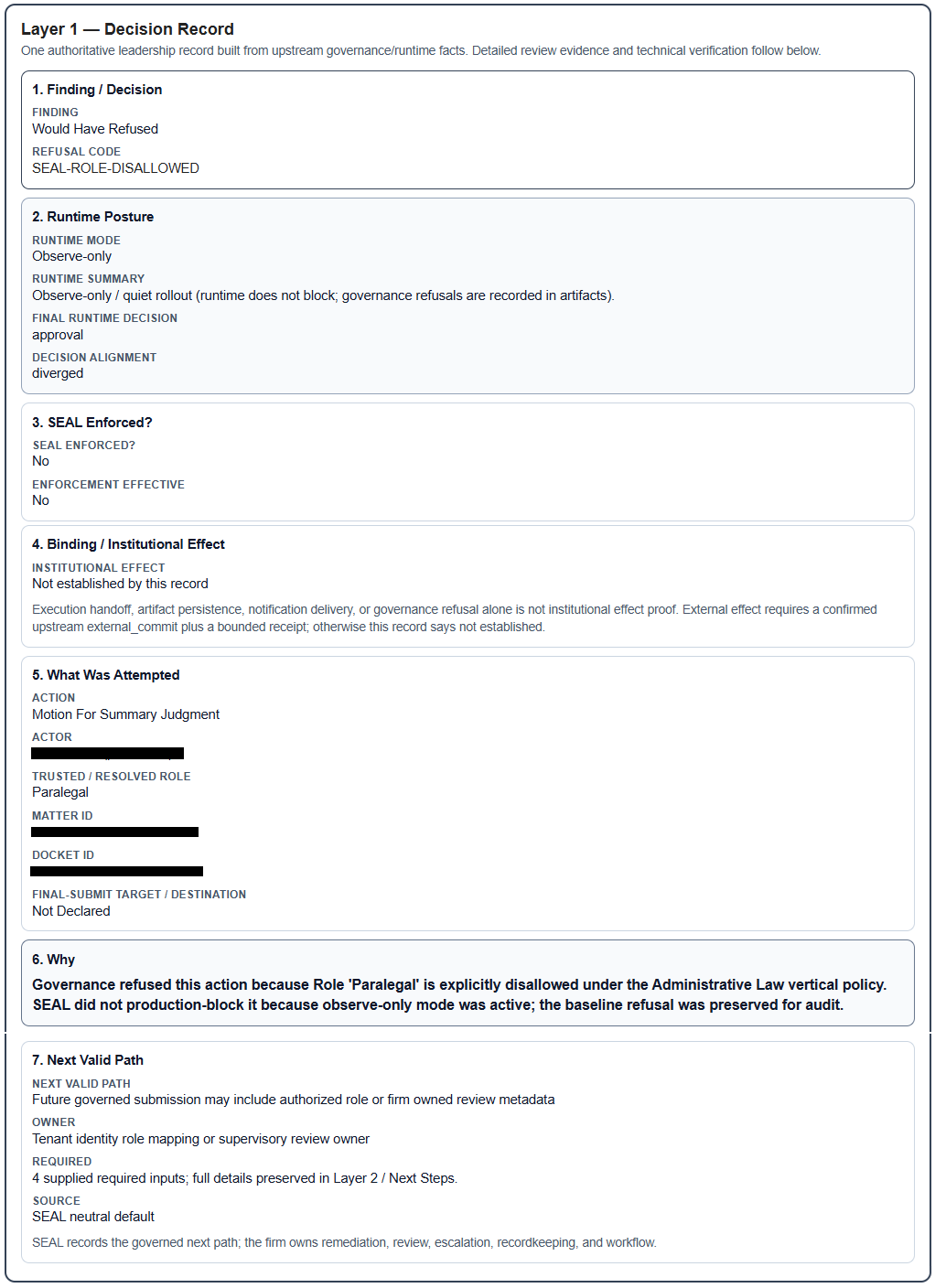
Screenshot below is from a simulated matter where a governed actor attempted to file under the wrong authority. The pre-execution authority gate refused the action and produced a refusal artifact the firm can use for regulator, insurer, or internal review later.
How It Differs from Adjacent Controls
A pre-execution authority gate occupies a different control point from systems institutions already rely on.
IAM establishes who or what may authenticate and access systems or resources.
- The gate asks whether that authenticated actor may take this particular consequential action under the required authority.
Model guardrails and model safety constrain model behavior and outputs.
- The gate governs the authority of the resulting action before commitment.
GRC and policy systems define, document, and oversee governance posture.
- The gate applies the relevant authority conditions at the action boundary.
Monitoring and observability provide visibility into what happened or is happening.
- The gate provides an authority decision before the scoped action becomes binding.'
These controls are complementary.
The distinction is which control point owns which question.
The Legal Example: SEAL Legal Runtime
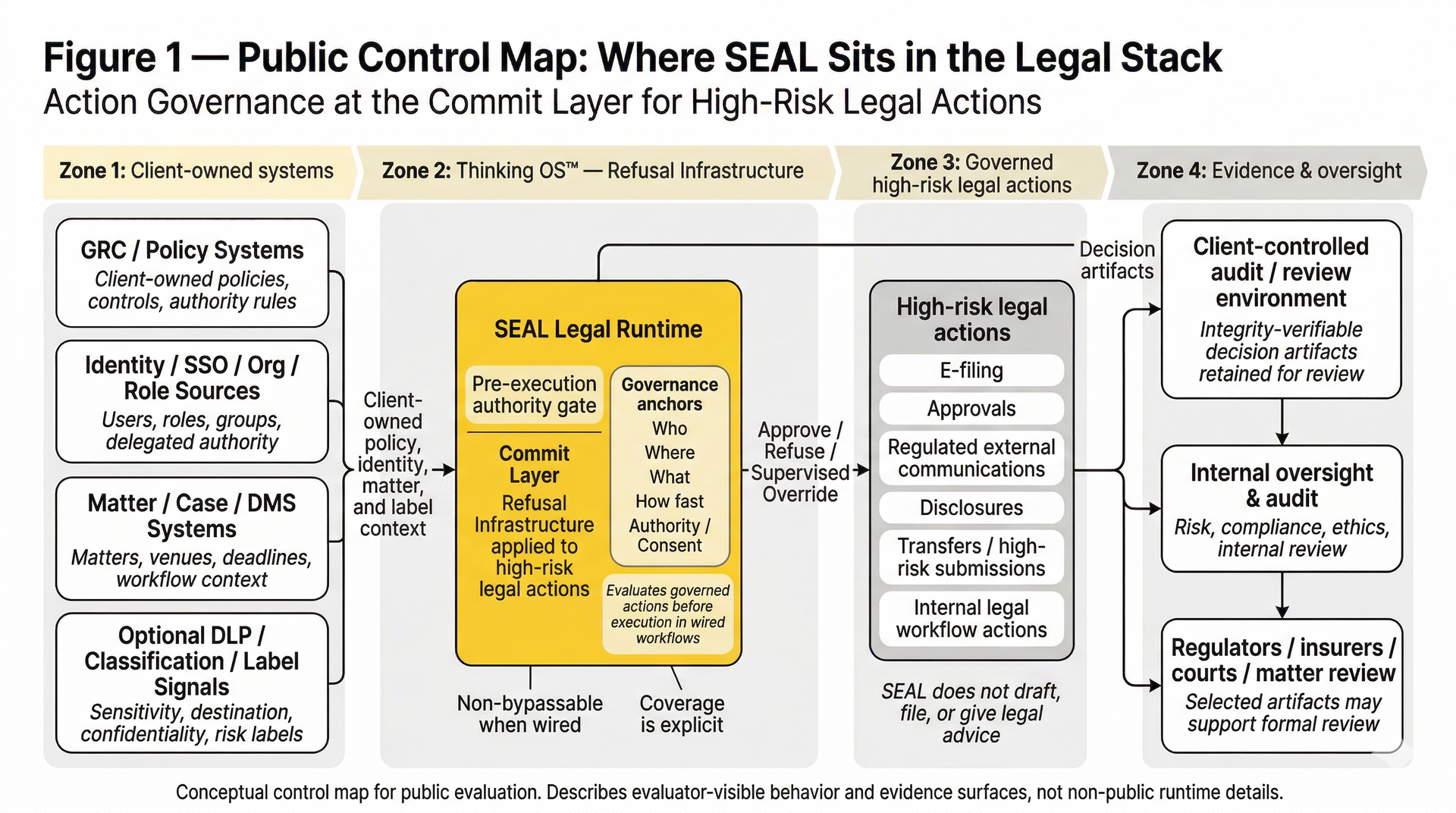
SEAL Legal Runtime is Thinking OS™’s legal implementation of the pre-execution authority-gate control type.
Consider one law-firm final-submit workflow.
Immediately before a filing leaves the firm, SEAL can evaluate:
Is this actor authorized to submit this filing, in this matter, under this authority, right now?
The governed outcome may be:
Approve — the configured authority conditions are satisfied.
Refuse — the required authority conditions are not satisfied.
Supervise — an authorized supervised path is required.
SEAL produces reviewable decision evidence for the governed outcome.
Current evaluation posture
The first law-firm evaluation is observe-only.
During Phase 1, SEAL records what would have been approved, refused, or routed for supervision without disrupting legal work.
Under separately scoped controlled enforcement, the governed outcome can become authoritative for the wired execution path.
The firm retains legal judgment, policy ownership, supervision, workflow operation, and responsibility for the underlying legal work.
SEAL governs the authority boundary. It does not practice law.
Where This Control Type Can Apply
A pre-execution authority gate can be relevant wherever an institution can identify a consequential action boundary and meaningful authority must exist before commitment.
Illustrative examples may include:
- financial transfers or approvals;
- regulated disclosures;
- healthcare orders or high-risk operational actions;
- critical infrastructure changes;
- public-sector or other regulated decisions.
The domain changes.
The structural question does not:
Before this action binds the institution, who has authority to let it proceed?
Thinking OS™ currently applies this control architecture first in legal through SEAL Legal Runtime.
The Takeaway
A pre-execution authority gate is the control type used at the Commit Layer.
It exists for the moment when upstream prerequisites have been satisfied but a consequential action has not yet bound the institution.
Its question is:
May this particular action proceed under institutional authority before commitment?
Thinking OS™ applies this control through its canonical stack:
Action Governance — the discipline
Commit Layer — the control point
Refusal Infrastructure — the architecture
Pre-execution authority gate — the control type
SEAL Legal Runtime — the legal product
In SEAL’s current law-firm evaluation posture, the control is observed first.
Controlled enforcement comes later only under separate written scope.