
SEAL Legal Runtime
Overview for Law-Firm Leadership
Before a Filing Leaves the Firm,
See Whether the Person or System Is Authorized to Submit It
Your existing systems stay in place.
SEAL Legal Runtime evaluates one narrow question at final submit:
Is this person or system authorized to take this filing action, in this matter, under the firm’s authority conditions?
Start with one filing workflow and a 30-day observe-only review.
No production filing is disrupted, delayed, or altered during the review.

One workflow · One final-submit boundary · 30 days · Observe-only
Your Current Systems Already Do Important Jobs
Your identity systems
establish who or what
is acting.
Your matter, DMS, docketing, and workflow systems
provide the context.
Your GRC and policy systems establish the firm’s rules and control posture.
SEAL does not replace those systems.
It asks a narrower question at the point immediately before external submission:
Is this person or system authorized to take this filing action, in this matter, under the firm's authority conditions?
How The 30-Day Review Works
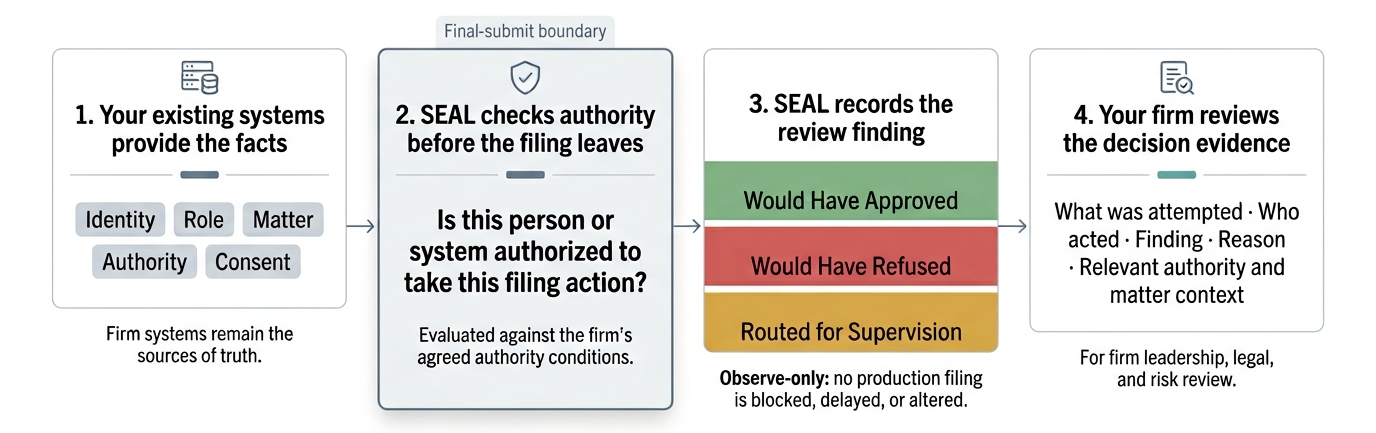
During the review, findings are:
- Would Have Approved
The agreed authority conditions appear satisfied. - Would Have Refused
One or more required authority conditions are not satisfied. - Would Have Routed for Supervision
The firm has identified the condition for supervised review.
Observe-only means exactly that: no production filing is dispruted, delayed, or altered during the 30-day review.
After 30 Days, Leadership Should Be Able to Answer:
Can we identify the real authority boundary?
- Can we reliably identify and observe the defined final-submit event?
Do our existing facts support the decision?
- Are identity, role, matter, authority, consent, and other required signals reliable enough to evaluate?
Do the findings make sense?
- Do approvals, refusals, and supervision findings align with the firm’s intended authority posture?
Is the evidence useful?
- Can legal and risk leadership understand the decision record without routine engineering interpretation?
Does SEAL add anything our existing controls do not already provide sufficiently well?
The review is not designed to prove that SEAL is necessary.
It is designed to determine whether the control is useful.
What SEAL Does – And Does Not Do
SEAL does
- evaluate one scoped authority question before external submission;
- use the firm’s existing governance facts;
- record Would Have Approved, Would Have Refused, or Would Have Routed for Supervision;
- produce a reviewable decision artifact;
- preserve explicit missing or conflicting required information rather than silently treating it as approval.
SEAL does not
- decide whether legal work is correct;
- replace lawyer judgment or professional supervision;
- replace IAM, GRC, DMS, matter, docketing, workflow, or filing systems;
- operate the firm’s supervision or escalation process;
- govern workflows outside written scope.
The firm owns the rules and legal judgment. SEAL evaluates the scoped authority question.
Why This Matters Now
The Actor Is Changing. The Authority Question Is Not.
Legal actions increasingly move through combinations of lawyers, staff, service accounts, workflow automation, integrated systems, and AI-enabled tools.
The actor may change.
The underlying institutional question remains:
Before the action leaves the firm, is this actor authorized to take it?
In many legal workflows, some of that authority checking has historically been carried through supervision, manual approvals, institutional knowledge, and workflow practice.
As legal workflows become more automated, those authority assumptions may need to become more explicit.
AI may increase the urgency. AI is not the category.
The Review Ends With a Decision
The 30-Day Review Does Not Presume Deployment
At the end of the review, leadership chooses one of four paths:
1. Stop
The existing controls are sufficient, the workflow is not a fit, or the additional control does not justify proceeding.
2. Continue Observe-Only
A defined question remains and additional observation is warranted.
3. Improve Signals and Re-Review
Identity, authority, role mapping, policy clarity, or workflow information needs improvement before anything further is considered.
4. Consider One Narrow Controlled-Enforcement Path
Only if the evidence supports it and the firm separately approves the exact workflow and refusal condition in writing.
Nothing moves into controlled enforcement automatically.
Start With One Filing Workflow
You do not need to decide whether SEAL belongs across the firm.
The first question is smaller:
Is there one filing or submission workflow where it would be useful to see the authority decision before the action leaves the firm?
30 days. One workflow. Observe-only.