
Verifier Note
How to Validate a Sealed Decision Artifact Without Relying on Vendor Narrative
Reference Note — for regulators, insurers, auditors, procurement, and technical evaluators
Status:
Public verifier note
Scope: What an evaluator should be able to verify from a sealed decision artifact, without access to vendor internals

1. Purpose
A sealed decision artifact is valuable only if a qualified third party can review it as decision evidence, not merely as a vendor-generated summary.
This note defines what an evaluator should be able to establish from the artifact and its supported verification surface without requiring access to proprietary runtime internals.
The goals are practical:
- confirm that a specific governed decision was recorded;
- determine what governance outcome was recorded;
- determine the runtime and binding posture where applicable;
- tie the record to the relevant action, context, and policy surface;
- inspect supported integrity indicators;
- understand what the artifact does and does not prove.
This note is intentionally evaluator-facing.
It is not a deployment guide, cryptographic specification, internal architecture document, or substitute for broader technical diligence.
2. What a Verifier Should Be Able to Establish
A sealed decision artifact should allow an evaluator to confirm, at minimum, the following categories of fact.
A. Decision identity
The artifact should provide sufficient stable identity and correlation information to distinguish a specific recorded decision from a screenshot, narrative summary, or unanchored report.
Representative evaluator-visible fields may include:
- decision or artifact identifier;
- timestamp;
- request, matter, or case reference where supplied;
- audit or correlation reference.
The question is:
Can this record be tied to one identifiable governed event?
B. Governance outcome, runtime posture, and binding effect
This is the major missing section in your current page.
A verifier should not assume that a governance outcome and the final runtime outcome are always identical.
Where applicable, the artifact should make clear:
- the baseline governance decision;
- the runtime mode;
- the final runtime outcome;
- whether the decision was binding;
- whether execution was attempted;
- whether governance and runtime remained aligned or diverged.
This is especially important in observe-only evaluation.
For example:
A governance decision may be Refusal while the production workflow remains nondisruptive because observe-only mode is active.
A serious verifier should be able to answer:
What did governance decide, and did that decision actually bind the production action?
C. Context and authority anchors
The artifact should provide enough context to understand the governed attempt without reconstructing the entire client workflow.
Relevant anchors may include:
- actor or trusted role;
- attempted action;
- matter, workflow, or domain context;
- authority, consent, evidence, or supervision posture;
- timing or urgency where relevant.
Missing facts should remain explicit.
A field that was not supplied should not be inferred or silently backfilled merely to make the artifact look complete.
D. Policy or rule-basis linkage
Where the runtime supplies policy or rule-basis references, a verifier should be able to determine which governance surface was associated with the recorded decision.
That may include:
- policy or rule-basis reference;
- policy set or version where supplied;
- decision/reason family;
- decision stage.
The verifier is not determining whether the policy was legally correct.
The question is:
Can this decision be associated with the governance posture represented as being in force at the time?
E. Integrity indicators
A verifier should have a supported way to inspect whether the decision record carries the integrity indicators represented by the product.
Public review need not expose the internal implementation.
The evaluator-visible surface may include:
- stable artifact identity;
- integrity-verifiable reference or indicator;
- audit/correlation linkage;
- stated retention or custody posture;
- supported verification result.
The goal is:
Can the evaluator perform the supported integrity review without needing proprietary runtime logic?
Example Sealed Decision Record (Redacted)
The following image is a redacted example of a refusal artifact generated by a pre-execution governance runtime.
It illustrates the type of fields evaluators should expect when reviewing a decision artifact.
Verification Example — Redacted Sealed Decision Record
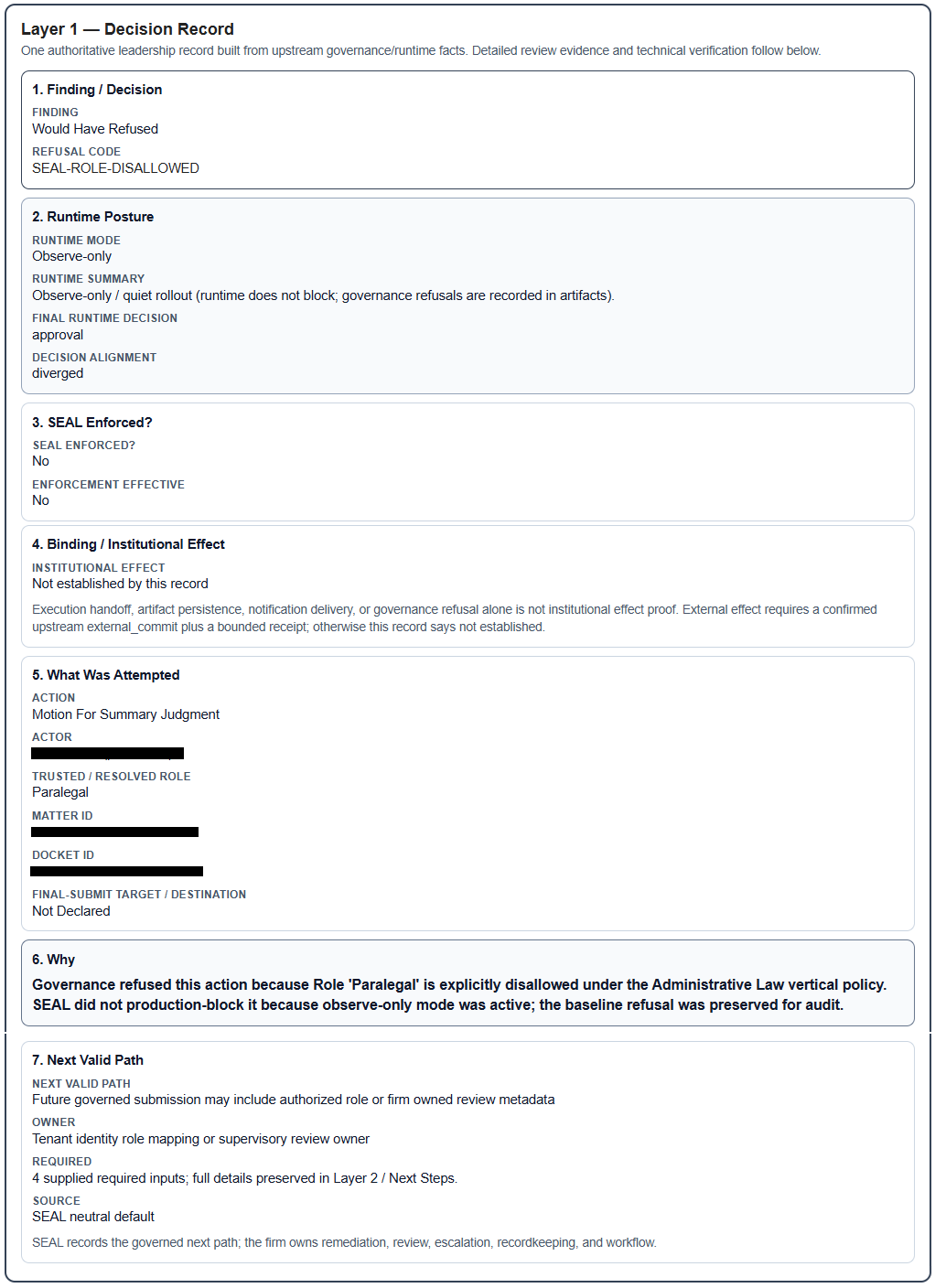
Note: This example is illustrative. Actual artifact formats vary by deployment, but the verification properties described above should remain consistent.
Redacted artifact example. Fields unrelated to verification have been removed.
3. What the Artifact Does Not Prove by Itself
A sealed decision artifact does not, by itself, establish:
- that the institution’s policy was legally correct, strategically wise, or professionally sufficient;
- that the upstream identity, matter, authority, evidence, or other source systems supplied correct information;
- that every workflow or execution path in the environment was governed;
- that no alternate unwired path existed;
- that buyer-environment production non-bypassability has been proven;
- that the internal runtime implementation is correct in every respect;
- that a downstream action actually executed or failed to execute unless appropriate execution evidence is included;
- that the artifact constitutes legal advice, regulatory approval, or a legal conclusion.
What the artifact can establish more narrowly is:
A specific governed decision was recorded with a specific evaluator-visible context and supported integrity evidence.
Where runtime, execution, or binding evidence is also present, the evaluator may be able to establish more.
4. Minimum Evaluator Procedure
A practical evaluator procedure should be simple and repeatable.
Step 1 — Identify the record
Confirm the decision has stable identity, time, and sufficient correlation information.
Step 2 — Separate governance from runtime
Identify:
- governance decision;
- runtime mode;
- final runtime outcome;
- binding effect;
- execution posture where supplied.
Do not flatten a governance refusal into a production refusal if observe-only mode was active.
Step 3 — Inspect the governed context
Confirm that the artifact exposes enough actor, action, authority, matter/workflow, and timing context to understand the decision.
Treat absent values as absent.
Do not infer missing facts.
Step 4 — Inspect policy / rule-basis linkage
Confirm the record identifies the represented governance surface or reason family where supplied.
Step 5 — Perform the supported integrity review
Inspect the available integrity indicators and supported verification procedure.
Do not infer undisclosed cryptographic or storage mechanisms from the public artifact.
Step 6 — Sample multiple outcome and mode types
A meaningful review should not rely on one refusal.
Where available, sample:
- approval;
- refusal;
- supervised path / override;
- observe-only refusal with nondisruptive runtime outcome;
- controlled-enforcement example, if that posture is actually in scope.
5. What Thinking OS™ Should Be Able to Demonstrate in Diligence
A qualified evaluator should be able to request, as appropriate:
- representative redacted decision artifacts across governed outcomes;
- explanation of evaluator-visible fields and their meaning;
- governance-versus-runtime/binding interpretation;
- policy or rule-basis linkage at a high level;
- supported integrity-review procedure;
- scope statement identifying governed versus out-of-scope paths;
- explanation of which evidence is client-controlled, vendor-controlled, or deployment-dependent.
That is sufficient to evaluate the
decision evidence surface without exposing proprietary runtime internals.
6. What This Note Is Not
This note is not:
- a complete artifact schema;
- a cryptographic specification;
- a key-management description;
- a deployment architecture;
- a runtime or rule-engine specification;
- a customer implementation guide;
- proof that all customer workflows are governed;
- proof of customer-environment production non-bypassability.
It is a public description of
what a qualified evaluator should be able to inspect from the decision evidence surface.
7. Why This Matters
The difference between ordinary operational logging and a sealed decision artifact is not formatting.
It is the purpose of the record.
Operational logs help explain system activity.
A sealed decision artifact is designed to preserve a reviewable record of:
- what governed action was evaluated;
- what governance outcome was returned;
- the relevant runtime and binding posture;
- which context and authority anchors were represented;
- which policy or rule surface was associated with the decision;
- whether the supported integrity review validates the record as presented.
The central verifier question is therefore not:
Does the vendor say it has governance?
It is:
Can a qualified third party reconstruct what the control decided, under what represented conditions, whether that decision bound the action, and what the artifact itself can legitimately prove — without requiring private runtime explanation?
That is the purpose of the sealed decision artifact.
That is what this verifier note is designed to make testable.