SEAL Legal Runtime
See Wrong-Authority Risk Before a Filing Leaves Your Firm
In 30 days, SEAL reviews one filing workflow and shows what would have been approved, refused,
or sent for supervision—without changing or disrupting production filings.
30 days. One workflow. Observe-only. No rip and replace.

Approve. Refuse. Supervise.
For one workflow in scope, SEAL records whether a final-submit action would have been approved, refused, or routed for supervision.
During the 30-day review, those outcomes are observed before enforcement is considered.
One Authority Decision Before the Filing Leaves Your Firm
You do not need another drafting tool, case system, or general-purpose AI guardrail.
You need a way to see whether the person taking the final-submit action had the required authority before the filing leaves.
Your existing systems already know who the person is, what matter they are working on, and what authority or consent exists. SEAL uses those facts at final submit to record whether the action would have been approved, refused, or sent for supervision.
Each result leaves a reviewable decision record.
SEAL does not replace GRC, IAM, matter systems, DMS, filing tools, or lawyer judgment; it evaluates the action boundary and produces decision records.
SEAL can refuse. It cannot file.
What SEAL Reviews Before a Filing Leaves the Firm
Your existing systems stay in place.
SEAL evaluates one final-submit authority question without disrupting production filings during the 30-day review.
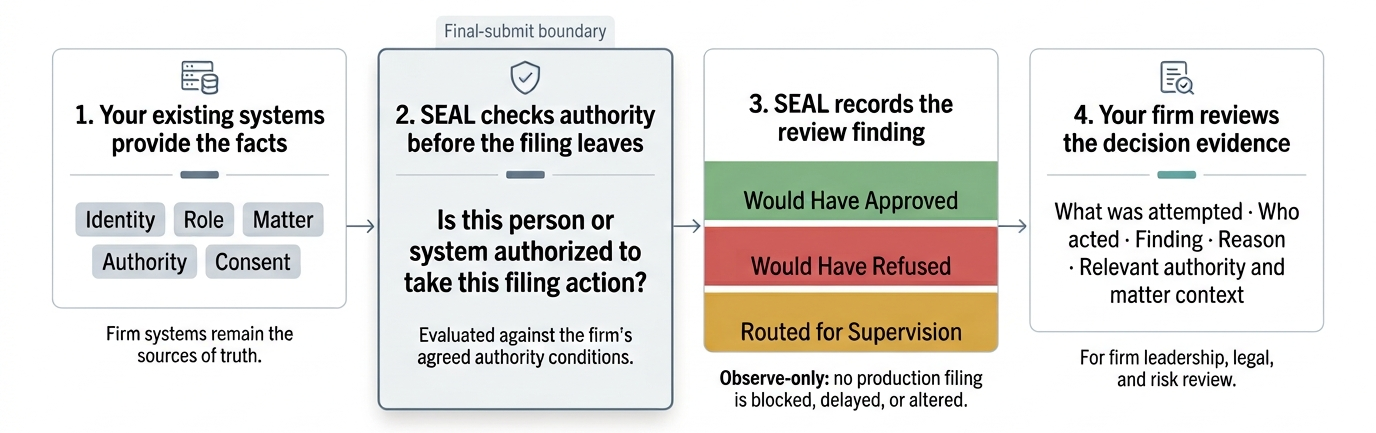
The review examines the authority decision at the moment before external submission — not only what happened afterward.
Proof Before Promises
You do not have to take SEAL on faith.
For one workflow in scope, leadership can verify:
- what would have been approved;
- what would have raised an authority or role issue;
- what would have required supervision;
- whether leadership can understand the resulting decision evidence.
When SEAL identifies a wrong-authority condition, the decision evidence shows what governed action was attempted, what outcome was returned, and the relevant authority and context behind that decision.
A 30-Day Observe-Only Review You Can Safely Say Yes To
The first review should feel narrow, bounded, and reversible.
We are not asking the firm to replace its systems or change legal practice.
We are asking to examine one final-submit boundary so leadership can see how the control behaves, whether the decision records are useful, and whether the available signals are strong enough to justify anything further.
Review structure
- one governed workflow
- one final file / submit boundary
- one named workflow owner
- one narrow role / authority scope
- one clear weekly review cadence
- observe-only and non-disruptive
- no production filing is blocked, delayed, or altered during the 30-day review
At the end of the review, the firm can stop, keep observing, improve signal quality, or consider one narrow enforcement path under separate written scope.
Nothing moves into controlled enforcement automatically.
The firm has clear pause and stop rights from the start.
Straight Answers To Your Trust Questions
Will this disrupt our filings?
No. During the 30-day observe-only review, SEAL does not block, delay, or alter production filings.
It reviews one final-submit workflow and records what would have been approved, refused, or routed for supervision. Your existing filing process remains in control.
What information does SEAL need?
Only the minimum structured information needed for the workflow being reviewed: who is acting, their trusted role, the action being taken, relevant matter or docket context, required authority or consent, and deadline information where needed.
SEAL does not require full matter files, broad DMS or database access, privileged strategy, passwords, private keys, or model prompts.
Does SEAL replace our systems or make legal judgments?
No. Your filing, docketing, matter, DMS, IAM, and GRC systems remain your sources of truth. Lawyers and supervisors remain responsible for legal judgment.
SEAL uses the firm’s existing governance facts to evaluate the authority question before the filing leaves.
A would-have-approved finding means the configured authority conditions were satisfied. It does not mean the filing was legally correct.
Who sets the rules — and who owns the records?
Your firm does.
The firm decides who may act, under what authority, what requires supervision, and which workflow is being reviewed.
The firm also owns its decision artifacts as business records and controls their retention, privilege, confidentiality, use, and disclosure.
Thinking OS owns the SEAL runtime and its proprietary internals.
What happens if something is missing, unclear, or looks wrong?
During the 30-day review, it becomes a review finding — not a production blocker.
SEAL does not turn missing or contradictory required information into silent approval. If a finding looks wrong, the decision record helps the firm determine whether the issue came from source data, authority mapping, policy, configuration, or the runtime.
Authority Near-Misses Are Hard to Measure
Before the Filing Leaves.
SEAL makes them reviewable.
SEAL does not just produce governance language. It gives leadership a measurable record of approvals, would-have-refused events, supervised-routing patterns, refusal reason codes, policy coverage, and downstream alignment.
That changes the conversation from interesting governance to buyer-grade evidence.
You can measure:
- wrong-authority filing attempts surfaced before external exposure
- would-have-refused events by workflow, role, and reason family
- supervised-routing patterns with named accountability
- repeat policy or signal gaps revealed by refusal reason codes
- downstream alignment between governed decision and execution posture
You can show insurers, regulators, auditors, and internal oversight functions what was approved, what would have been refused, what required supervision, and why.
This is not just governance. It is a measurable ledger of risk signals before consequence.
Built for the People Responsible for the Final-Submit Risk
Managing Partners
See whether one filing workflow has authority, role, or supervision gaps before enforcement is ever considered.
GCs / Risk Leaders
Review decision records showing what would have been approved, refused, or routed before a filing leaves the firm.
Legal Ops / IT / Workflow Owners
Review one final-submit workflow using minimum structured signals without replacing your matter system, DMS, IAM, GRC, or filing tools.
How SEAL Fits
The discipline of governing whether a consequential action may proceed under institutional authority before commitment.
The control point before a consequential action becomes binding. In SEAL’s first legal use case, that is the final-submit boundary before a filing leaves the firm.
Legal example: the final-submit boundary before a filing leaves the firm.
The architecture that makes Action Governance operational at the Commit Layer through a governed pre-execution authority control.
Thinking OS™’s product applying this architecture to high-risk legal actions.
SEAL is not a chat wrapper, dashboard, or after-the-fact log.
It gives leadership a governed authority decision before the filing leaves the firm. — with reviewable decision evidence for each outcome.
See Wrong-Authority Filing Risk
Before It Leaves Your Firm — and Prove It
SEAL gives law firm leadership a narrow, reviewable authority decision at one final-submit boundary.
It does not replace your systems.
It does not replace legal judgment.
It does not decide whether a filing is legally correct.
It evaluates one governed final-submit workflow and records what would have been approved, refused, or routed for supervision before the filing leaves the firm.
30 days. One workflow. Observe-only first. No filing production blocking during the 30-day review.