Refusal Infrastructure: The Missing Control Before High-Risk Legal Actions Bind
Most governance stops too early.
It can tell you what
policy says.
It can tell you who
has access.
It can tell you what
system was used.
It can tell you what
happened afterward.
All of that matters.
But in high-risk institutional work, the harder question comes later:
Before the action leaves, was this actor allowed to take this action, in this context, under this authority, right now?
That is the question most governance stacks still do not own.
- A filing leaves the firm.
- A disclosure goes out.
- An approval binds.
- A transfer moves.
- A submission commits the institution.
Once that happens, governance is no longer deciding. It is explaining.
The missing control point
The missing control is not another dashboard.
It is not another policy library.
It is not another after-the-fact audit trail.
The missing control is a governed point before execution.
That is the Commit Layer.
Thinking OS™ uses this hierarchy deliberately:
Action Governance
is the discipline.
The Commit Layer
is the control point.
Refusal Infrastructure
is the architecture.
SEAL Legal Runtime
is the product for high-risk legal workflows.
AI may be one actor in a governed workflow.
It is not the category.
The category is the control of high-risk institutional action before it binds.
Why after-the-fact governance is not enough
Upstream governance matters.
A system should be approved before it enters the workflow.
Data should be governed.
Users should be authenticated.
Models should be evaluated.
Policies should be written.
Roles should be defined.
Downstream review also matters.
Logs, audits, investigations, dashboards, and reports are useful.
But neither layer, by itself, owns the moment where an action becomes real.
That is the final-submit boundary.
The send boundary.
The approval boundary.
The disclosure boundary.
The transfer boundary.
If governance does not have authority there, it is not controlling the action.
It is reacting to it.
What refusal means
Refusal is not failure.
A refusal is a governed outcome.
In serious workflows, “no” has to be owned. It has to be reviewable. It has to preserve the evidence of why the action did not proceed.
Sometimes the actor is wrong.
Sometimes authority is missing.
Sometimes supervision is required.
Sometimes consent is incomplete.
Sometimes the work is urgent, but the action still cannot bypass governance.
The better pattern is not:
Blocked. Good luck.
The better pattern is:
Refused. Here is why. Here is the record. Here is the path for review.
That is the difference between a brittle blocker and Refusal Infrastructure.
Decision artifact, not dashboard
Logs matter.
But logs are not enough.
A log usually tells you what happened inside a system.
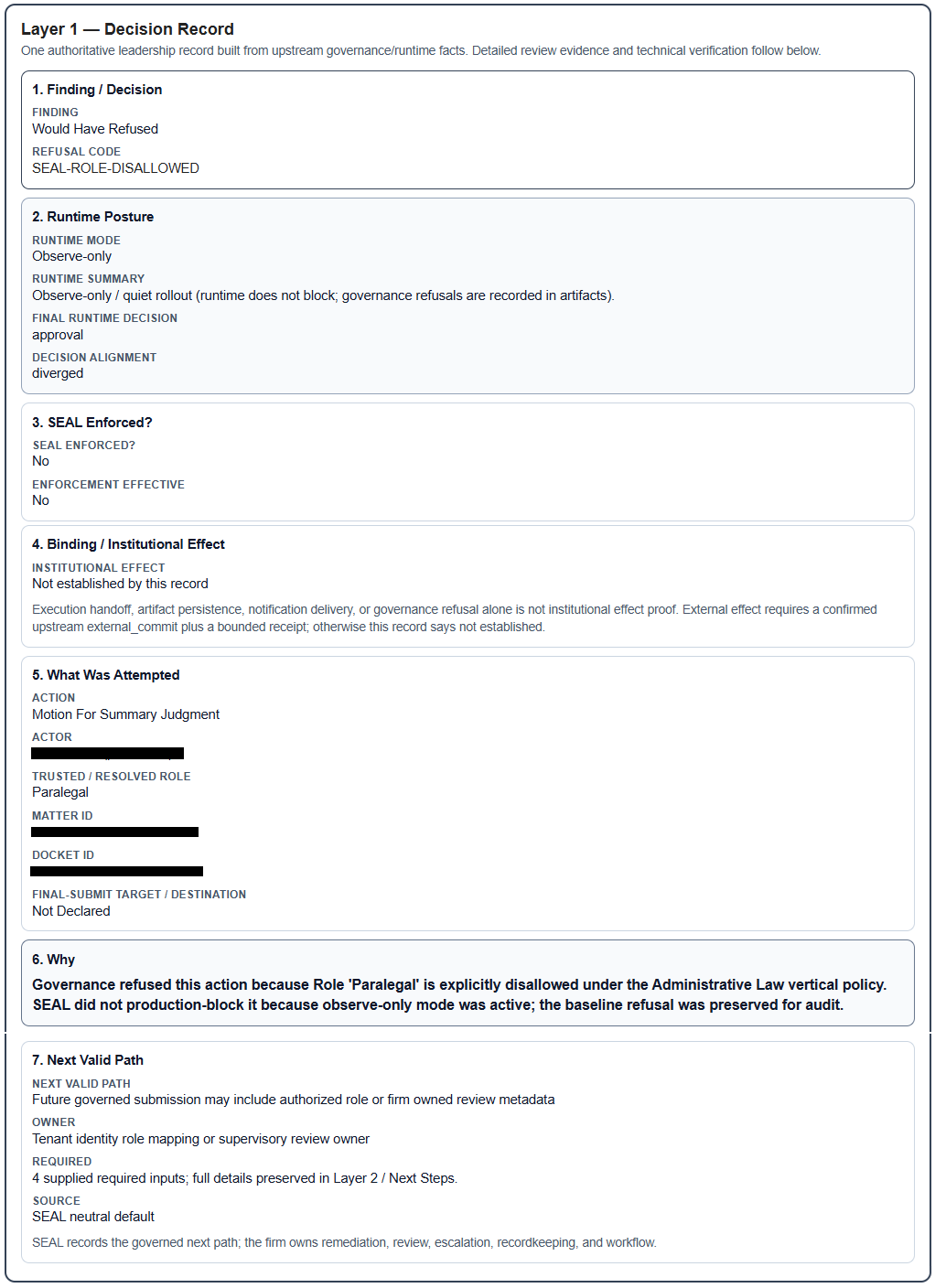
A decision artifact should show what was allowed, refused, or routed at the action boundary.
For high-risk workflows, the useful evidence is not only:
who clicked,
what system ran,
what event was recorded,
or what workflow executed.
The useful evidence is whether the governed action was allowed to proceed before the institution was committed.
That is the evidence surface serious buyers, risk leaders, insurers, legal teams, and technical reviewers increasingly need to understand.
What this is not
This is not a claim that one runtime solves every governance problem.
Runtime authority control does not replace:
- legal judgment,
- professional supervision,
- model validation,
- identity systems,
- GRC programs,
- matter systems,
- document systems,
- filing tools,
- data governance,
- security review,
- policy design,
- or regulatory approval.
Those layers still matter.
Upstream governance decides whether the system belongs in the workflow.
Runtime control decides whether a particular action is allowed to bind.
That distinction is the heart of Action Governance.
Why AI makes this urgent, but is not the category
AI makes the problem easier to see because it makes action faster, cheaper, and easier to scale.
But the governance problem is broader than AI.
Any actor that can bind the institution needs authority before execution.
A human can act under the wrong authority.
A service account can move the wrong file.
A workflow can submit the wrong record.
A script can trigger the wrong transfer.
An AI agent can send, file, approve, or disclose before anyone notices.
The control problem is not intelligence.
The control problem is institutional authority.
Before the action leaves, the institution needs a governed point that can say:
Yes.
No.
Not yet — route for supervision.
Why legal is the first proving ground
Legal work makes the boundary obvious.
Once something is filed, sent, approved, or disclosed, it usually cannot be treated as if it never happened.
That is why SEAL Legal Runtime starts with a narrow legal use case:
wrong-authority filing refusal at the final-submit boundary.
The point is not firmwide transformation.
The point is not broad AI governance.
The point is not replacement of existing legal systems.
The point is one governed action boundary.
Can a firm place a reviewable pre-execution authority gate in front of one final-submit workflow without disrupting normal legal practice?
That is the first question.
The line
Governance is not real if the action already left.
Policies matter.
Access matters.
Validation matters.
Monitoring matters.
But when a high-risk action is about to bind the institution, the stack needs something more specific:
a governed point that can approve, refuse, or route before the action proceeds.
That is Action Governance.
The control point is the Commit Layer.
The architecture is Refusal Infrastructure.
SEAL Legal Runtime applies it to high-risk legal workflows.
Current posture
Thinking OS™ is not asking firms to rip out existing systems or turn on firmwide enforcement.
The current motion is narrow design-partner evaluation.
- One workflow.
- One final-submit boundary.
- Observe-only first.
- No disrupting legal work in Phase 1.
- No replacement of lawyers, legal judgment, GRC, IAM, matter systems, DMS, or filing tools.
The purpose is to let the firm observe the gate before enforcing it.
Interpretation and use notice
This article is public category education from Thinking OS™.
It is not legal advice.
It is not a technical specification.
It is not an implementation guide.
It is not customer proof.
It does not grant any right to copy, emulate, or implement Thinking OS™, SEAL Legal Runtime™, Refusal Infrastructure™, or any sealed runtime behavior.