Everyone’s Optimizing AI Output. Almost No One Governs What Can Execute.

Patrick McFadden • August 27, 2025

Legal AI has crossed a threshold. It can write, summarize, extract, and reason faster than most teams can verify.


But under the surface, the real fracture isn’t about accuracy. It’s about actions that were never structurally authorized to run.


Here’s the gap most experts and teams still haven’t named.


1. Everyone’s Still Optimizing the Response


Most legal AI conversations still orbit the same questions:


  • How fast is it?
  • How accurate is the draft?
  • Can it cite?
  • Does it save time?


All important. None of them answer the one question that actually shows up in court or with insurers:

“Given this actor, this matter, and this authority — was this action ever allowed to execute at all?”

A system can be 100% right on analysis and still not be allowed to act.


Until you have a structural way to say no at the action boundary, performance is not proof of governance.

2. The “Governance Layer” Is Mostly After the Fact


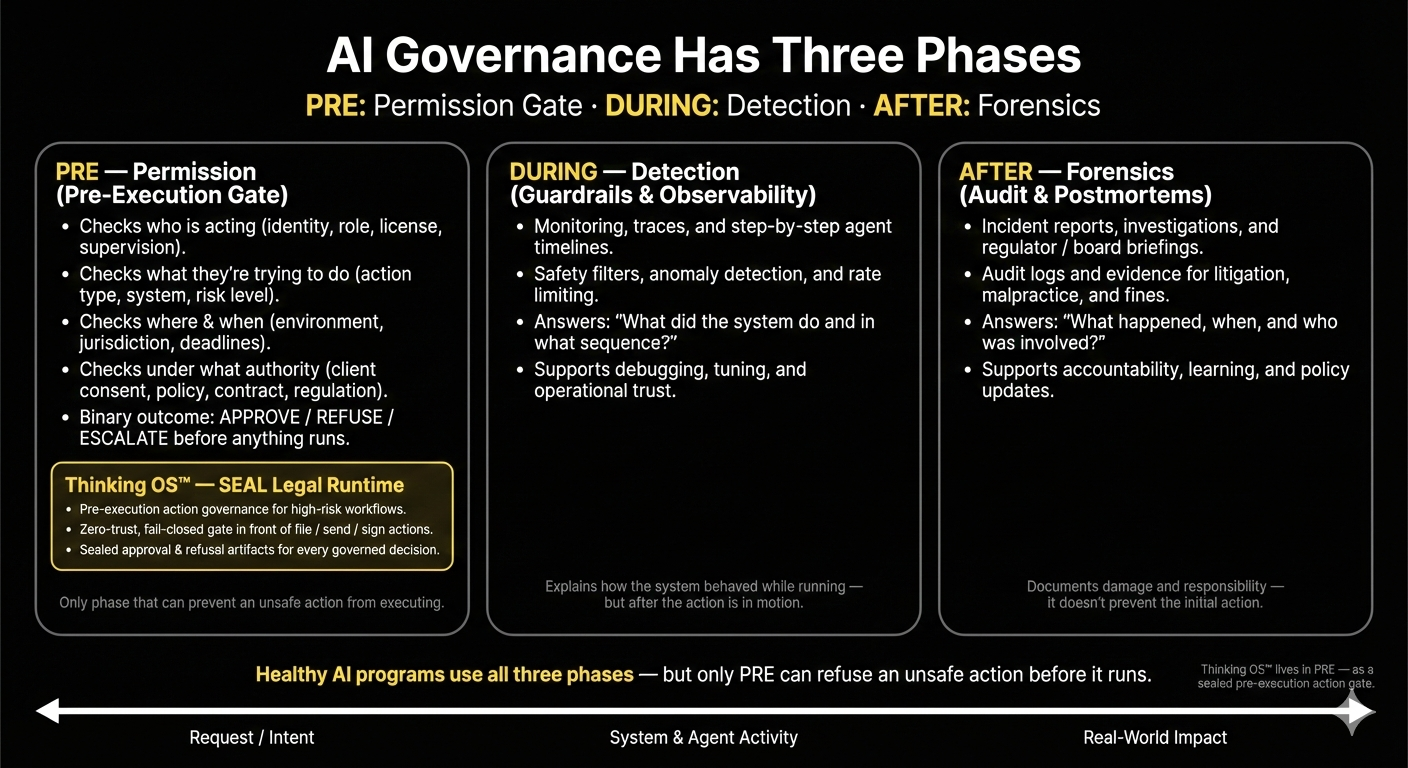
What most teams call “governance” today is post-execution control:


  • Filters and guardrails
  • RAG pipelines
  • Usage policies and playbooks
  • Human-in-the-loop review
  • Logs and dashboards


All necessary. All downstream.


By the time those kick in, the risky part already happened:


  • The AI-drafted email was sent.
  • The filing left the building.
  • The approval hit the system of record.


That isn’t governance. That’s forensics.


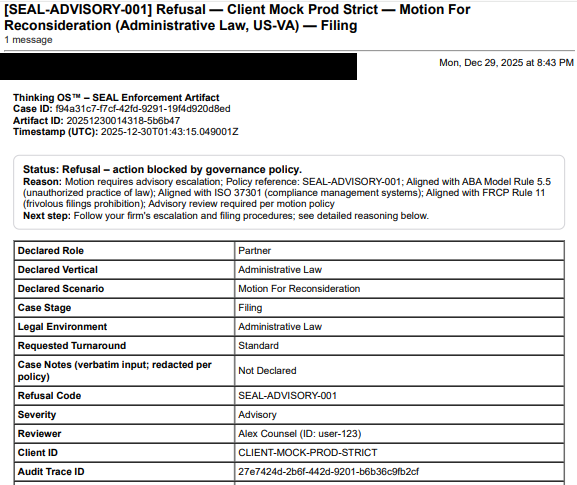
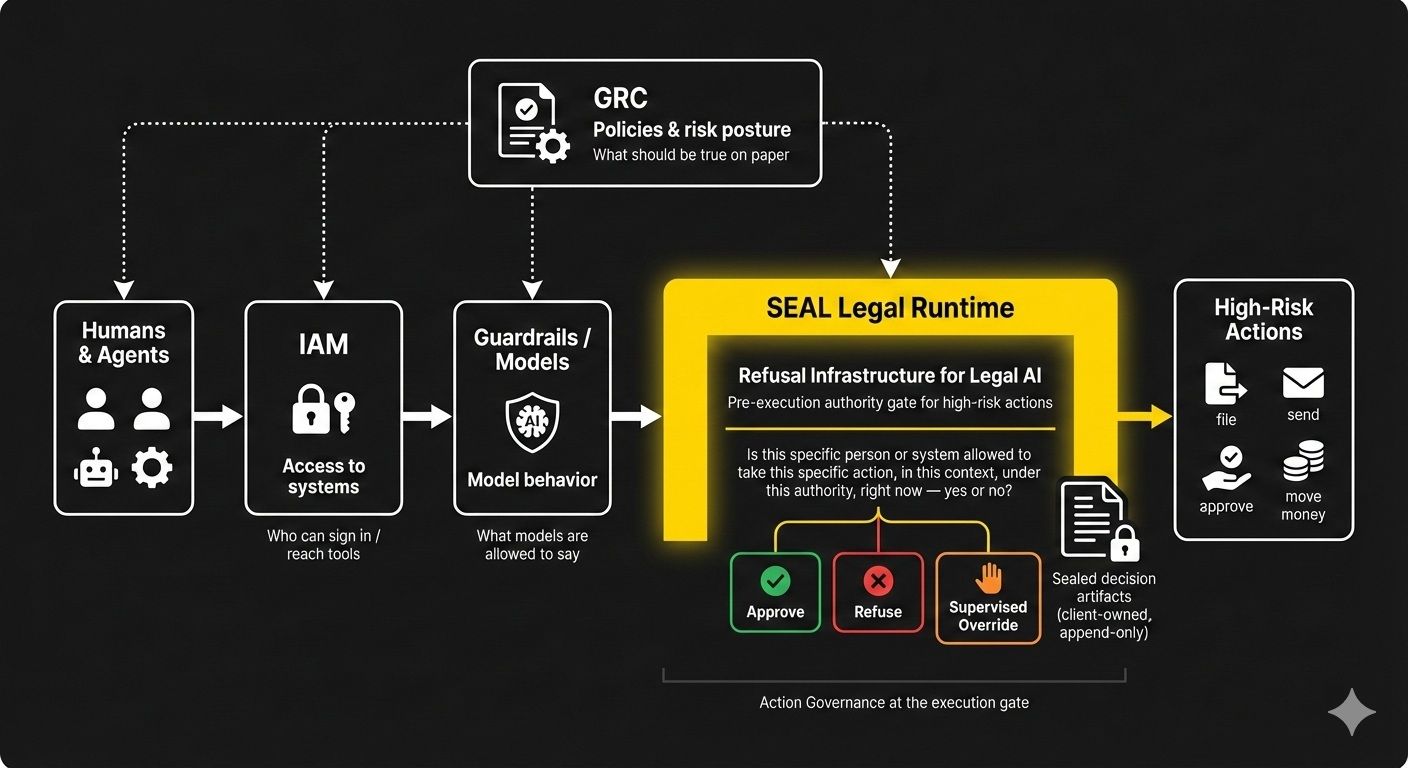
Real governance needs a pre-execution authority gate in front of high-risk steps — a layer that can say:

“For this specific person or system, in this matter, under this authority, may this file / send / approve action proceed right now: allow / refuse / escalate?”

If no one is answering that question in real time, you don’t have runtime governance. You have hopes.

3. Judgment Is Being Misdefined


In most AI programs, “judgment” gets treated as:


  • Picking the best draft,
  • validating citations, or
  • asking “does this look right?” after the system runs.


That’s quality control, not judgment.


In regulated environments, judgment is structural:

Judgment is the condition under which an action is permitted to exist in the real world.

It’s not “do we like this answer?”
It’s
“is anyone explicitly authorized to let this action happen at all?”


That’s the discipline we call Action Governance:


  • Who may act
  • On what
  • Under whose authority
  • In this context
  • At this moment


Enforced before a filing, communication, or approval leaves the firm.


Without that pre-execution authority gate, you can have beautiful context graphs, decision traces, and model monitoring — and still no structural way to stop the wrong thing from happening under your seal.

Final Thoughts


Legal AI isn’t drifting because the models are bad.


It’s drifting because we let systems act on our behalf without a non-bypassable answer to a simple question:

“Is this specific action allowed to execute, right now?”

The real edge over the next 12–24 months won’t be better prompting or prettier copilots.


It will be refusal infrastructure at the execution gate — action governance that can block, not just observe, what your AI stack is allowed to do.


Until that exists in your stack, the risk isn’t just what AI says.
It’s what you’ve given it the power to do.


By Patrick McFadden February 3, 2026
Everyone’s talking about Decision Intelligence like it’s one thing. It isn’t. If you collapse everything into a single “decision system,” you end up buying the wrong tools, over-promising what they can do, and still getting surprised when something irreversible goes out under your name. In any serious environment— law, finance, healthcare, government, critical infrastructure —a “decision” actually has three very different jobs: 
By Patrick McFadden January 13, 2026
One-line definition A pre-execution authority gate is a sealed runtime that answers, for every high-risk action:  “Is this specific person or system allowed to take this specific action, in this context, under this authority, right now — approve, refuse, or route for supervision?” It doesn’t draft, predict, or explain. It decides what is allowed to execute at all.
By Patrick McFadden January 11, 2026
If you skim my AI governance feed right now, the patterns are starting to rhyme. Different authors. Different vendors. Different sectors. But the same themes keep showing up: Context graphs & decision traces – “We need to remember why we decided, not just what happened.” Agentic AI – the question is shifting from “what can the model say?” to “what can this system actually do?” Runtime governance & IAM for agents – identity and policy finally move into the execution path instead of living only in PDFs and slide decks. All of that matters. These are not hype topics. They’re real progress. But in high-stakes environments – law, finance, healthcare, national security – there is still one question that is barely named, much less solved: Even with perfect data, a beautiful context graph, and flawless reasoning… 𝗶𝘀 𝘁𝗵𝗶𝘀 𝘀𝗽𝗲𝗰𝗶𝗳𝗶𝗰 𝗮𝗰𝘁𝗼𝗿 𝗮𝗹𝗹𝗼𝘄𝗲𝗱 𝘁𝗼 𝗿𝘂𝗻 𝘁𝗵𝗶𝘀 𝘀𝗽𝗲𝗰𝗶𝗳𝗶𝗰 𝗮𝗰𝘁𝗶𝗼𝗻, 𝗳𝗼𝗿 𝘁𝗵𝗶𝘀 𝗰𝗹𝗶𝗲𝗻𝘁, 𝗿𝗶𝗴𝗵𝘁 𝗻𝗼𝘄? That’s not a data question. It’s not a model question. It’s an authority question.  And it sits in a different layer than most of what we’re arguing about today.
By Patrick McFadden December 30, 2025
Designing escalation as authority transfer, not a pressure-release valve.
By Patrick McFadden December 30, 2025
Why Thinking OS™ Owns the Runtime Layer (and Not Shadow AI)
By Patrick McFadden December 28, 2025
System Integrity Notice Why we protect our lexicon — and how to spot the difference between refusal infrastructure and mimicry. Thinking OS™ is: Not a prompt chain. Not a framework. Not an agent. Not a model. It is refusal infrastructure for regulated systems — a sealed governance runtime that sits in front of high-risk actions, decides what may proceed, what must be refused, or what must be routed for supervision, and seals that decision in an evidence-grade record.  In a landscape full of “AI governance” slides, copy-pasted prompts, and agent graphs, this is the line.
By Patrick McFadden December 23, 2025
Action Governance — who may do what, under what authority, before the system is allowed to act.
By Patrick McFadden December 15, 2025
Why “PRE, DURING, AFTER” Is the  Only Map That Makes Sense Now
By Patrick McFadden December 15, 2025
Why Every New AI Standard  Still Leaves Enterprises Exposed
By Patrick McFadden December 9, 2025
You Can’t Insure What You Can’t Govern