When to Install Thinking OS™

You Don’t Install Thinking OS™ After AI Moves
You Install It Before High-Risk Actions Execute.
Every architecture has a boundary moment — the point where a system stops exploring possibilities and is allowed to do something in the real world.
Thinking OS™ doesn’t get installed after that moment.
It
becomes that moment.
Don’t Install Thinking OS™ If:
- You want a wrapper to clean up downstream AI outputs.
- You’re still shopping for LLMs and prompt tooling with no critical workflows in scope.
- You believe governance is a checklist, not an execution block.
- You’re comfortable with velocity exceeding refusal.
Install Thinking OS™ If:
- Agents or workflows are being deployed that can file, send, approve, or move without a hard stop.
- Judgment is being outsourced to reasoning surfaces with no traceable authority behind final actions.
- AI is influencing strategy, spend, or system motion — and no one can prove what it was not allowed to execute.
- Your compliance layer only audits outputs, not who was allowed to act, on what, under which authority.
Structural Timing:
When the Architecture Is Still Containable
When the Architecture Is Still Containable
Thinking OS™ is not a governance plugin.
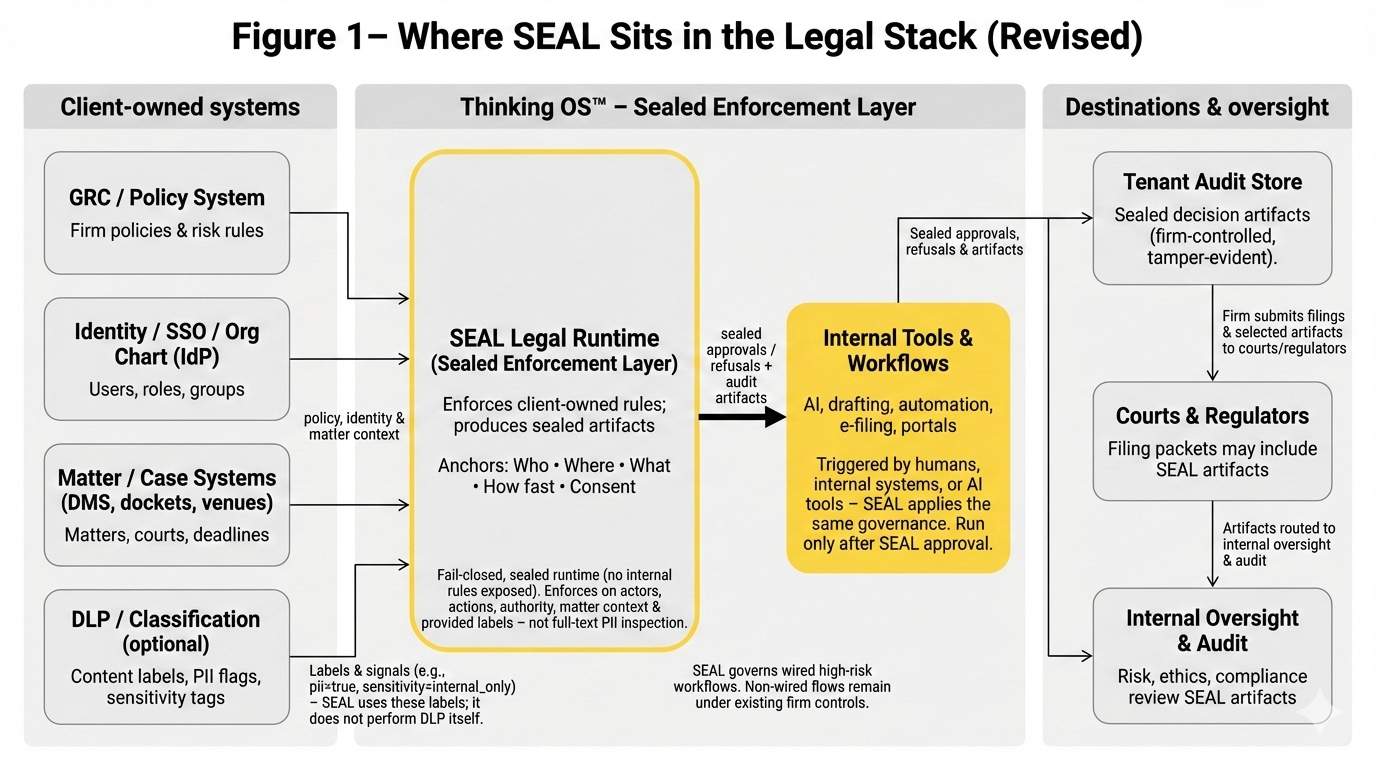
It is refusal infrastructure — a sealed governance runtime that must be wired in before your high-risk actions are allowed to run.
Install it at the layer:
- Before orchestration connects multiple agents to real systems.
- Before domain deployment embeds AI in regulated workflows (filings, approvals, client comms).
- Before prompt tuning gives the illusion of control.
- Before risk review becomes retroactive instead of pre-emptive.
Once high-risk actions are already flowing without a gate, Thinking OS™ is not a patch.
It’s the boundary you forgot to build.
Action Without Refusal
Is Not Innovation. It’s Drift.
You can’t retrofit refusal.
You can’t audit clarity after the action has already executed.
And when it breaks, you won’t need more AI.
You’ll need the
judgment layer that should have refused it.
Install Thinking OS™:
- At the moment of upstream architecture, not downstream patching.
- At the boundary of action initiation, not model configuration.
- At the point of role and authority definition, not role improvisation.
- At the decision surface, not just in the audit trail.
Remember: The Actions You Allow to Execute Are The Governance You’ve Actually Deployed.
Thinking OS™ enforces refusal before execution — so what should never run, never runs under the seal.
If you’re deploying agents, reasoning pipelines, or autonomous workflows:
You don’t have a future-proof AI architecture
until
Thinking OS™ is the gate every high-risk action passes through.
Thinking OS™
Refusal Infrastructure for Legal A
I Installbefore execution. Not
after collapse.