
See Wrong-Authority Risk
Before a Filing Leaves Your Firm
Without Disrupting Legal Work
30-Day Observe-Only Final-Submit Review for Law Firms

SEAL helps law-firm leadership review one final-submit workflow and
see what would have been approved, refused, or routed for supervision. The 30-day review is observe-only
without disruption: no production filing is blocked, delayed, or altered.
One workflow.
One owner.
Thirty days.
Observe-only.
No rip and replace.
Reviewable decision artifacts.
The Problem
Most firms can review what happened after a filing leaves.
But leadership often has a harder question:
What should have been caught before the filing left?
A login shows access.
A workflow step shows that work moved.
A document system shows the filing existed.
An audit log shows what happened afterward.
But none of those automatically prove:
Was this actor authorized to take this legal action, in this matter, under this authority, before the firm was committed?
That is the gap this review is designed to examine.
The Offer
A Narrow, Paid Observe-Only Evaluation
30 days · one workflow · observe-only · $40,000 fixed fee
The 30-Day Observe-Only Final-Submit Review is designed to help a firm evaluate one governed legal action boundary safely.
This is not a firmwide rollout.
This is not production enforcement.
This is not a replacement for your filing system, DMS, matter system, IAM, GRC, or lawyer judgment.
It is a focused review of one designated final file / submit workflow.
During the review, SEAL records what would have been:
Would Have Approved
A governed request that appears to satisfy the configured authority posture.
Would Have Refused
A would-have-refused event, such as wrong authority, role mismatch, missing condition, or invalid authority evidence.
Routed for Supervision
A situation where the firm may want a supervised review path before any enforcement is considered.
Why Observe-Only?
Law firms should not be asked to trust a new control blindly.
The 30-day review is observe-only so leadership can see how the control behaves, whether the available signals are reliable, and whether the decision artifacts are useful before deciding whether anything further is justified.
The review is non-disruptive. No production filing is blocked, delayed, or altered.
At the end of the review, the firm can:
- stop
- keep observing,
- improve signal quality,
- adjust workflow ownership,
- review refusal patterns,
- or consider one narrow controlled-enforcement path under separate written scope.
Nothing moves into controlled enforcement automatically.
What the Review Helps You See
The review is designed to surface questions like:
- Did the trusted actor and resolved role match what the workflow declared?
- Was the action tied to the correct matter, docket, client, motion, or submission type?
- Was authority missing, invalid, stale, mismatched, or reused?
- Did a paralegal, staff member, lawyer, service account, or AI workflow actor appear in the final-submit path?
- Did a deadline-sensitive condition warrant supervised review under the configured posture?
- Could leadership understand the evidence without engineering support?
What You Get
1. Firm-Confirmed Authority Posture
What the firm considers authorized, not authorized, or requiring supervision for the selected workflow.
2. Review Scope Memo / Charter
One workflow, one final-submit boundary, named owners, agreed authority conditions, review objectives, and explicit exclusions.
3. Minimum Signal Map + Readiness Decision
Where each required fact comes from, who owns it, whether it is available before final submit, and whether the workflow is ready for observation.
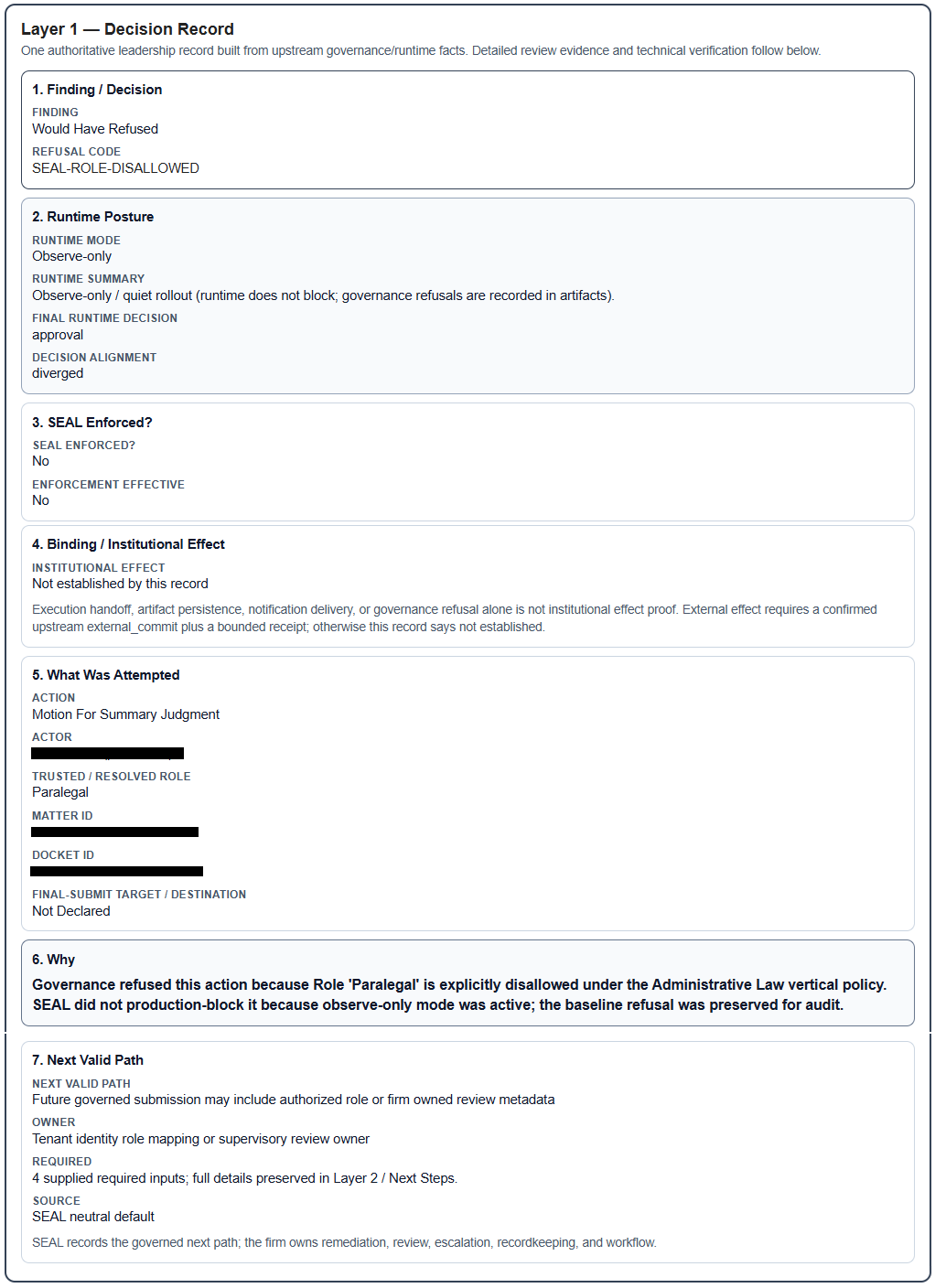
4. Weekly Review Sessions + Reviewable Decision Artifacts
A short weekly review of what would have been approved, what would have been refused, and what patterns are emerging. Plain-English artifacts showing outcome, reason, binding effect, authority posture, evidence anchors, and next valid path.
5. Final Risk Ledger
A summary of would-have-approved events, would-have-refused events, supervised-review patterns, reason categories, signal issues, and recommendations.
6. Leadership Recommendation
At the end of 30 days: stop, keep observing, improve signals, or consider a narrow enforcement path under separate written scope.
What This Does Not Do
SEAL does not provide legal advice.
SEAL does not decide legal strategy.
SEAL does not determine whether a filing is legally correct, ethically required, or jurisdictionally sufficient.
SEAL does not replace lawyer judgment.
SEAL does not become your matter system, filing system, DMS, GRC, IAM, workflow tool, or ticketing system.
SEAL does not govern workflows that are not wired into the review.
The firm owns policy, supervision, legal judgment, workflow routing, artifact retention, and any escalation path.
Example Review Question
A request may say the role is Attorney.
But trusted identity may resolve the actor as Paralegal, Staff Member, Filing Automation, or AI Workflow Agent.
The review asks:
Should that actor have been able to take this final-submit action before the filing left the firm?
In observe-only mode, SEAL preserves the would-have-refused finding without disrupting production during the 30-day review.
That gives leadership visibility before enforcement is ever considered.
Who This Is For
Managing Partners
who want visibility into final-submit authority risk before anything moves toward enforcement.
General Counsel / Risk Leaders
who need reviewable evidence of what governed a filing before the firm was committed.
COOs / Executive Directors
who care about workflow risk, operational ownership, and evaluating new controls without a broad rollout.
Litigation Support / Docketing / Legal Ops Leader
who understand how filings actually move through people, systems, authority, and deadlines.
Best-Fit Firms
This is most useful for firms with:
- active litigation or regulatory filing workflows,
- delegated filing steps,
- paralegal or staff-supported final-submit processes,
- docketing or legal ops involvement,
- high-volume or deadline-sensitive submissions,
- automation or AI appearing near filing workflows,
- or leadership concern around authority, consent, supervision, or review evidence.
Review Structure
Observation period: 30 days
Posture: Observe-only and non-disruptive
Scope: One final-submit workflow
Owner: One named workflow owner
Review cadence: Weekly
Output: Decision artifacts + final risk ledger + leadership recommendation
Production enforcement: None during the review
Fee: $40,000 fixed-fee evaluation
Why This Is Different
This is not another approval checklist.
This is not another after-the-fact audit log.
This review focuses on the moment before consequence:
the final-submit boundary.
The goal is to help leadership answer:
Before this legal action left the firm, what governed it?
And if something would have been refused:
Can we see why, what evidence existed, what was missing, and what the next valid path should have been?
Straight Answers To Your SEAL Questions
Will this disrupt lawyers?
The review is designed not to. It is observe-only and non-blocking. SEAL records what would have been approved, refused, or routed for supervision, but no production filing is disrupted, delayed, or altered during the 30-day review.
Does SEAL replace our current systems?
No. Existing systems remain the sources of truth. SEAL evaluates the governed action boundary using the structured identity, role, matter, authority, evidence, and workflow signals supplied for the review.
Do we need a major integration project?
Not for the 30-day review. The review starts with one workflow, one final-submit boundary, and the minimum structured signals needed to evaluate that action. Any deeper production integration is separately scoped only if the firm later chooses to consider controlled enforcement.
Does a SEAL approval mean the filing is legally correct?
No. A would-have-approved finding means the request satisfied the firm’s configured authority posture. It does not mean the filing is legally correct, strategically wise, ethically sufficient, or jurisdictionally proper. Lawyers remain responsible for legal judgment.
What happens if SEAL finds something?
In observe-only mode, it becomes a review finding. The firm reviews the decision artifact, the reason, the available evidence, and any signal issue. Nothing changes in production automatically.
Is this production-ready enforcement?
No. This offer is not production enforcement. Any later controlled-enforcement path requires separate written scope, signal-quality review, supervision and fallback review, security and continuity review, production wiring review, and firm approval.
Is this AI governance?
No. AI may be one possible actor, but the review is broader. The same authority question applies to lawyers, paralegals, staff, service accounts, filing automation, workflow systems, and AI agents.
Start With One Workflow
SEAL does not ask your firm to change legal practice overnight.
It gives leadership a narrow way to inspect one final-submit boundary, observe would-have-refused events, and decide whether the evidence is useful.
30 days. One workflow. Observe-only and without disruption. No production filing is disrupted, delayed, or altered during the review.
Disclaimer
For information only. Not legal advice. SEAL does not provide legal judgment, legal strategy, filing advice, ethics advice, or professional-responsibility advice. Any production enforcement requires separate written scope, security review, and firm approval.